How to Create LinkedIn Content as a Software Engineers: Complete 2026 Guide
A step-by-step guide covering everything Software Engineersneed to know about creating consistent, high-quality LinkedIn content — from finding ideas to posting your first carousel.
If you’re a software engineer who knows LinkedIn matters but never quite gets around to posting, this guide is for you. The timing has rarely been better: most people in your field either stay silent or recycle the same generic updates, which leaves a wide-open lane for anyone willing to teach honestly and share what actually works. LinkedIn is where recruiters, founders, and fellow engineers gather, so a public reputation there directly opens doors to better roles and opportunities. Its format rewards clear, lesson-driven content — turning everyday engineering into career leverage. That gap is the opportunity — the software engineerwho publishes specific, useful content becomes the name people remember, refer, and reach out to, while equally capable peers stay invisible. You already have the expertise; what’s missing is a repeatable process for turning it into posts without sacrificing your actual work. That’s exactly what the seven steps below give you, along with the post ideas, content pillars, and hashtags to start with today.
Time to first post with CarouseLabs: About 20 minutes including onboarding — most engineers turn a real problem from their week into a first teaching carousel the same day.
What Content Creation Looks Like for Software Engineers
The Old Way
Before CarouseLabs, building an engineering reputation was something you meant to do and never did. Between sprints, code review, and on-call, writing a thoughtful technical post always lost — and context-switching out of deep work to wrestle with prose felt genuinely costly. So the hard problems you solved every week, the exact material that would have marked you as a sharp practitioner, stayed in PRs and Slack threads. Meanwhile the senior roles, conference invites, and recruiter DMs went to engineers who'd figured out how to be visible, even when their actual work was no better than yours.
The CarouseLabs Way
With CarouseLabs, your everyday engineering work becomes the content that builds your career. A gnarly bug becomes a teaching post. A technical concept becomes a clear explainer that demonstrates both depth and communication skill. An outage becomes a reflection that reads as senior judgment. Because you batch a week in one session, reputation-building never interrupts your flow state — and consistency compounds into the recruiter DMs, conference invites, and staff-level opportunities you used to watch go to louder, not better, engineers.
Step-by-Step: How to Create LinkedIn Content as a Software Engineers
- 1
Decide what you want your engineering reputation to be
You're not selling a product — you're building a reputation that leads to better roles, higher offers, and influence. Decide the technical identity you want: the distributed-systems person, the developer-experience advocate, the pragmatic architect. Anchoring your content to one area makes you the name people associate with it. In a field where hiring is relationship- and reputation-driven, a visible technical identity is worth more to your career than another certification.
20 min, onceCarouseLabs Tip: CarouseLabs keeps your content anchored to your technical identity, so your feed builds a focused reputation rather than scattered opinions.
- 2
Turn the problems you debug into teaching content
Every gnarly bug, architecture decision, and refactor you handle is content other engineers want. Keep a note of the technical problems you solve and the reasoning behind your choices. These lived, specific examples are far more valuable than recycled tutorial content, because engineers want to see how a real practitioner thinks through trade-offs. Your daily work is a continuous stream of teachable moments that most engineers never share.
5 min a dayCarouseLabs Tip: CarouseLabs turns a short note about a technical problem you solved into a teaching post, so your daily work becomes career-building content.
- 3
Write hooks that name a real engineering pain
Engineering hooks land when they name a shared frustration or a hard-won lesson: 'We spent 3 weeks on a caching layer we didn't need. Here's how to tell.' Leading with a specific, technical reality — not a generic 'clean code matters' take — earns respect from a skeptical audience allergic to fluff. Engineers scroll past platitudes but stop for concrete war stories with a real technical lesson inside.
10 minCarouseLabs Tip: CarouseLabs generates hooks around real engineering pains, so your posts earn respect from an audience that scrolls past platitudes.
- 4
Build a carousel that explains a technical concept clearly
Structure a carousel around one concept: how a system works, why an architecture choice matters, a debugging methodology. Walk through the problem, the naive approach, the insight, the solution, and the trade-off. Explaining technical depth clearly is a rare and valued skill — it demonstrates both your knowledge and your communication ability, which is exactly the combination that gets engineers promoted into senior and staff roles where influence matters more than raw code output.
20 minCarouseLabs Tip: CarouseLabs builds the full technical-explainer carousel from your notes, so your depth becomes clear, shareable content without an evening of writing.
- 5
Share the failures and trade-offs honestly
The outage you caused, the design you regret, the premature optimization that cost weeks — these honest posts build more authority than any success story, because they demonstrate the judgment that only comes from being wrong. Engineering is a craft of trade-offs under uncertainty, so showing you can reflect honestly on a mistake signals exactly the maturity that senior and staff engineers are hired for.
10 minCarouseLabs Tip: CarouseLabs helps you shape a technical failure into a reflective lesson that reads as senior judgment rather than an admission of weakness.
- 6
Post consistently without it eating your focus time
Engineers guard deep work fiercely, and rightly so — context-switching to write posts is costly. Batch a week of posts in one session so your reputation-building never competes with your flow state. Consistency is what compounds into the recruiter DMs, conference invites, and opportunities that follow visible engineers, while equally skilled but invisible engineers watch those opportunities go elsewhere. Protecting deep work and building a reputation aren't mutually exclusive if you batch.
50 min for a weekCarouseLabs Tip: CarouseLabs lets you batch a week at once, so reputation-building never interrupts your deep work or flow state.
- 7
Present code and concepts cleanly and consistently
Technical content lives or dies on clarity, so a clean, consistent visual identity makes your explainers easy to follow and your feed recognizable. Clear presentation of complex ideas is itself a demonstration of the communication skill that separates senior engineers from strong coders. Lock in your template once so every explainer and war story carries the same clean polish, letting the technical substance stay the focus.
15 min first time, automatic afterCarouseLabs Tip: Upload one reference and CarouseLabs keeps every carousel clean and consistent, so your technical content reads as clearly as you think it.
What Software Engineers Achieve in Their First Week with CarouseLabs
Your first technical explainer that proves you can communicate depth clearly — the senior-engineer differentiator.
A batched week of posts that builds your reputation without interrupting deep work.
Your first recruiter or peer DM referencing a post — proof your feed is becoming a career asset.
The 5 Topics Software Engineers Should Build Their Content Around
The hardest part of posting consistently isn’t writing — it’s deciding what to write about every single time. Content pillars solve that. Instead of starting from a blank page, you rotate through a small set of themes you’ve already committed to, so every post has a home before you write a word. These five pillars are the ones that work for Software Engineers specifically: together they balance teaching, credibility, and personality, which is the mix that grows an audience rather than just filling a feed. Pick one pillar per post and rotate through them over a fortnight. You’ll never run dry, your audience will know what to expect from you, and your feed will build a coherent reputation instead of reading as scattered thoughts.
- 1
Craft & Best Practices — code review, readability, and writing for the next engineer
- 2
Career Growth — the habits and moves that take engineers from junior to senior and beyond
- 3
Problem-Solving — debugging methods and hard-won system design lessons
- 4
Engineering Judgment — when to optimize, when to simplify, and what actually matters
- 5
Dev Culture — the philosophy and tradeoffs behind great engineering teams
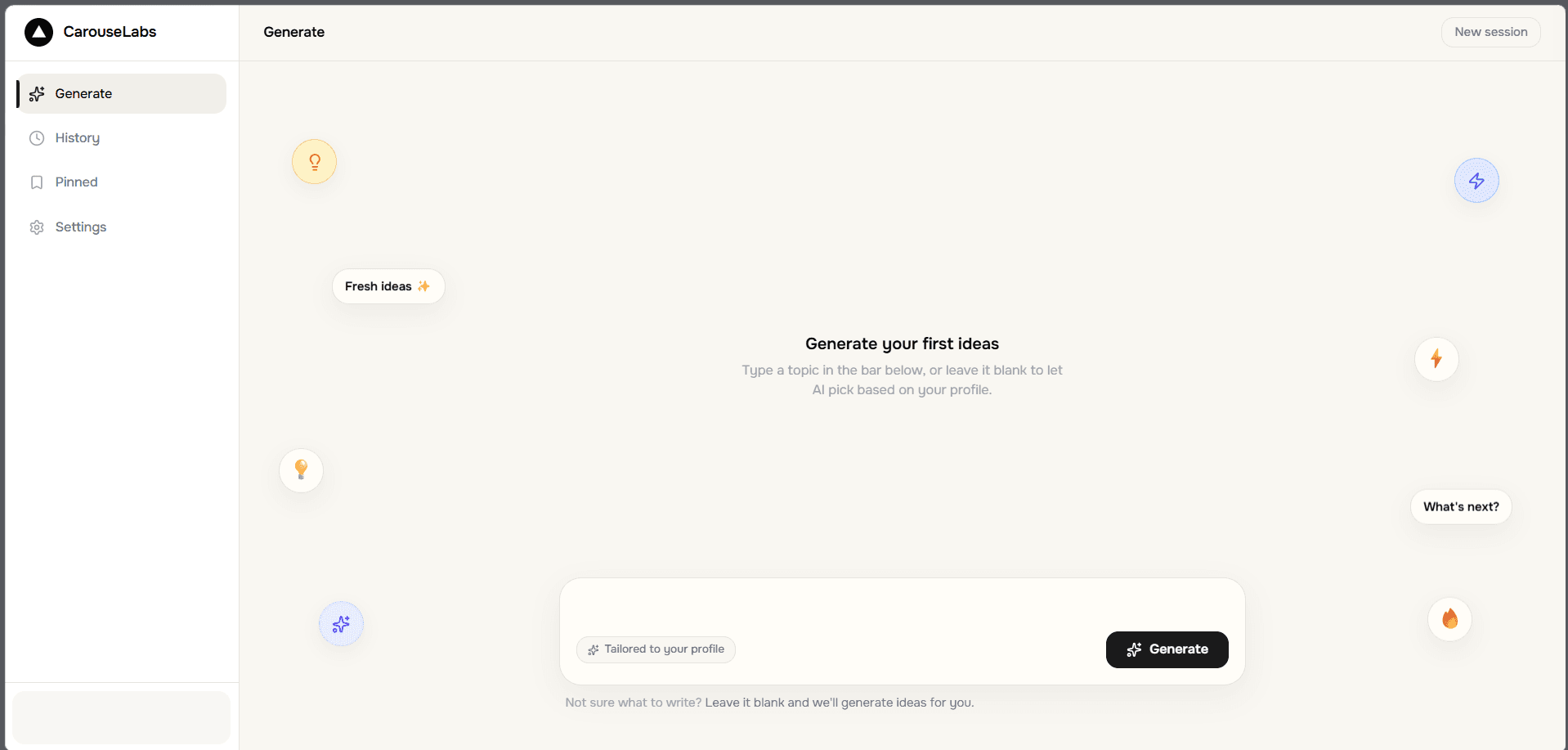
10 LinkedIn Post Ideas to Get You Started as a Software Engineers
Hashtags Software Engineers Should Use
Ready to Create Your First Post as a Software Engineers?
Stop spending hours on content. CarouseLabs handles the ideas, captions, and visuals — you just hit publish.
Start creating for freeNo credit card required
Related Resources for Software Engineers
Guides for related niches