Why Is My Hidden Image Not Working
A clear explanation of why hidden images fail on X, and what is actually happening behind the scenes when they do.
Free · No login required
Skip ahead and start now, or read the full guide below.
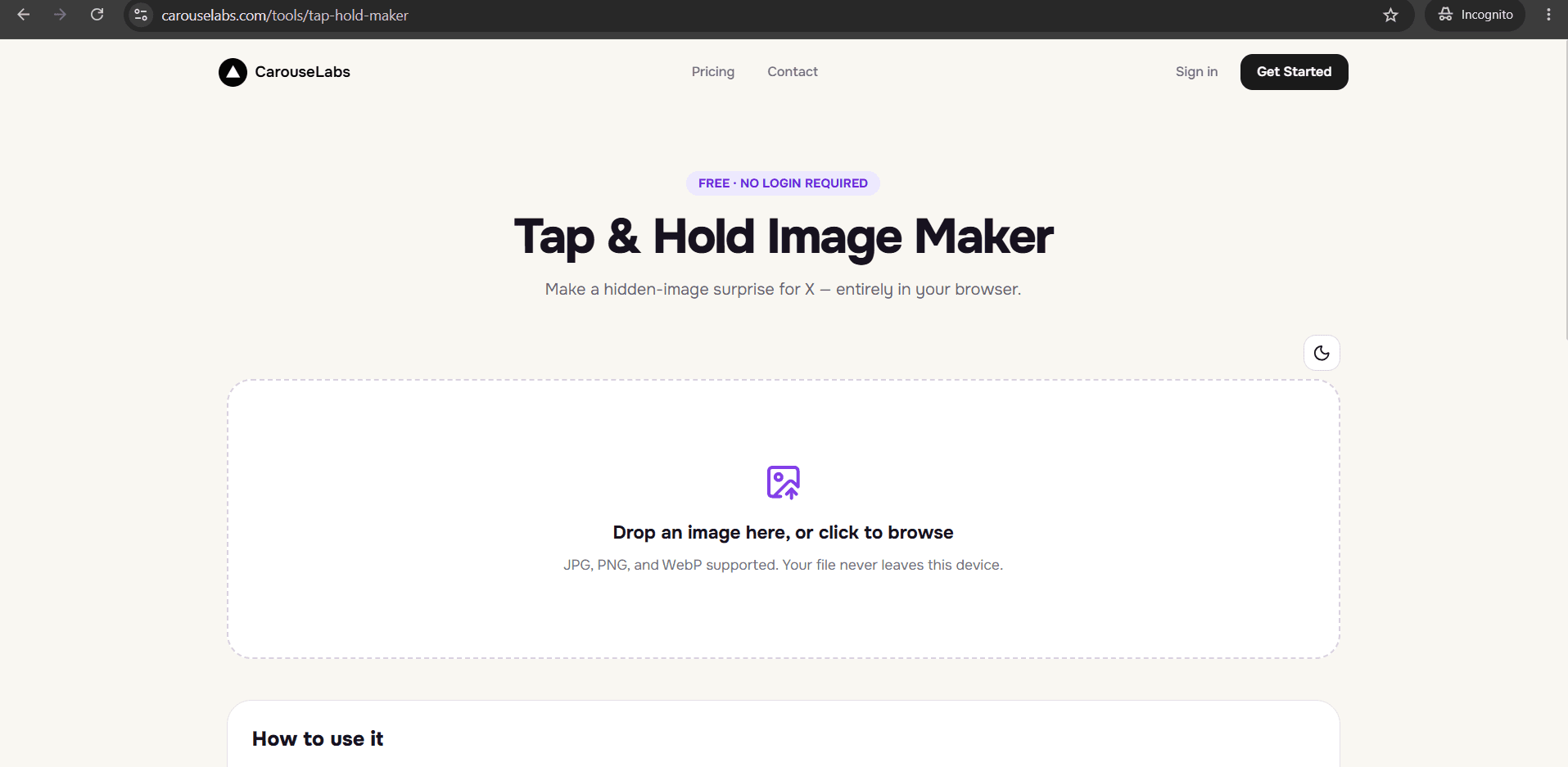
It is a specific kind of frustrating when a hidden image just displays as a normal, fully-visible photo — or reveals nothing extra at all — after you were sure you set it up correctly. Understanding why this happens makes it much easier to fix, because the cause is almost always mechanical rather than random.
This page explains what is actually going on when a hidden image fails, rather than just listing fixes, so you can diagnose it correctly the next time it happens too.
What “Why Is My Hidden Image Not Working” Means
A hidden image relies on a real gap between two different ways X renders the same file: the heavily compressed version shown while scrolling the timeline, and the higher-quality version briefly shown during a tap-and-hold press. The 'hidden' effect only exists because those two renders can look meaningfully different when the file is built correctly.
When a hidden image 'does not work,' it means that gap has been erased somewhere in the process — either the file was recompressed again after export (so both renders now look the same), or the file was never built with enough of a difference between visible and hidden regions to notice in the first place.
Why People Use This Effect
This question gets asked constantly because the failure is genuinely invisible during editing — everything can look perfect in a preview and still break once the platform touches the file again. Without understanding why, it is easy to assume the whole technique is unreliable, when in reality the cause is narrow and identifiable.
It also comes up often because the two real explanations are not obvious unless someone has already run into them: most people naturally suspect their brush strokes or the image itself, when the actual cause is usually about the export format or the app used to upload it.
How to Create This with CarouseLabs
Here is the correct process that avoids both underlying causes, using the free CarouseLabs Tap & Hold Image Maker.
- 1
Start from the Tap & Hold Image Maker directly
Go to /tools/tap-hold-maker and work from your original image file rather than a previously downloaded export, to avoid layering extra compression.
30 sec - 2
Upload the unedited source image
Choose your JPG, PNG, or WebP file directly from your device. It is processed locally in the browser, preserving the quality needed for a clear gap between views.
15 sec - 3
Paint a deliberate, meaningful hidden area
Use the brush to leave a clearly smaller portion visible than hidden. A subtle brush job is a common reason the two render states look too similar to notice.
1-2 min - 4
Compare Timeline View and Tap & Hold View directly
Look at both panels side by side. If they look nearly identical, the hidden area needs to be more deliberate before you export.
30 sec - 5
Export specifically with Download for X
This produces the indexed PNG-8 file built for X's timeline compression — the format most likely to preserve the gap between the two render states.
10 sec - 6
Upload the file to X from a desktop browser
Post using desktop web rather than the mobile app, since the app's own compression pass is what most often collapses the gap between timeline and reveal after upload.
20 sec
Try it as you read
Open the maker in another tab and follow along with the steps above.
Tips for Better Results
Understand it is about compression, not magic
There is no special trick being 'broken' when a hidden image fails — it is a straightforward compression mismatch, which is why the fix is always mechanical.
Treat desktop web as the default posting method
Since the mobile app is the most common source of a collapsed gap, make posting from desktop web your default habit for every tap and hold image, not just a fix you reach for after something fails.
Choose PNG-8 for anything going to X
The PNG-8 export in the CarouseLabs Tap & Hold Image Maker exists specifically because it holds up to X's compression better than other formats.
Make the hidden portion unmistakably larger than the visible portion
A wide gap between the two states is more resilient to any remaining compression than a narrow one.
Re-verify after any platform update you notice
If a technique that worked before suddenly seems inconsistent, re-export a fresh PNG-8 file rather than assuming your original file is still current with X's behavior.
Examples
Case: reveal worked in preview, not on X
The file was likely exported as WebP or posted via the mobile app — re-export as PNG-8 with Download for X and post from desktop web.
Case: reveal is barely noticeable
The visible and hidden portions were too close in size — go back and paint a smaller visible area for a clearer gap.
Case: reveal worked once, then stopped on a later post
Confirm the same posting method (desktop web) and export format (PNG-8) were used consistently — inconsistent habits are the most common cause of intermittent failures.
Common Mistakes
Assuming the brush strokes themselves are the problem
Fix: In most cases the brush work is fine — check the export format and posting method first before redoing your strokes.
Re-uploading a file that already went through another app once
Fix: Start from your original, unedited source image in the CarouseLabs Tap & Hold Image Maker rather than a file that has already been compressed elsewhere.
Using the WebP export for an X post
Fix: Use Download for X to get the PNG-8 file — WebP is meant for sharing outside X and does not hold up the same way to timeline compression.
Posting through the X mobile app
Fix: Switch to desktop web for uploading. This resolves the gap-collapsing issue in the large majority of cases.
Frequently Asked Questions
A hidden image that stops working is not a mystery — it means the compression gap the whole effect relies on was narrowed somewhere between editing and posting. Identify whether it is the export format or the upload method, and the fix is usually immediate.
Rebuild the file with Download for X in the CarouseLabs Tap & Hold Image Maker and post it from a desktop browser to restore the effect.
Make your why is my hidden image not working right now
Everything above happens inside one free browser tool — no signup, no design software.
Create your Tap & Hold image nowFree forever · Works entirely in your browser