Creative Tap and Hold Images
Artistic and storytelling ways to use the tap and hold format, beyond memes and marketing.
Free · No login required
Skip ahead and start now, or read the full guide below.
Most tap and hold content on X leans toward memes or marketing, but the underlying mechanic — a visible teaser and a hidden reveal — is just as useful as a storytelling and artistic device. This page focuses on the creative side: illustration, photography, and layered narrative uses of the format.
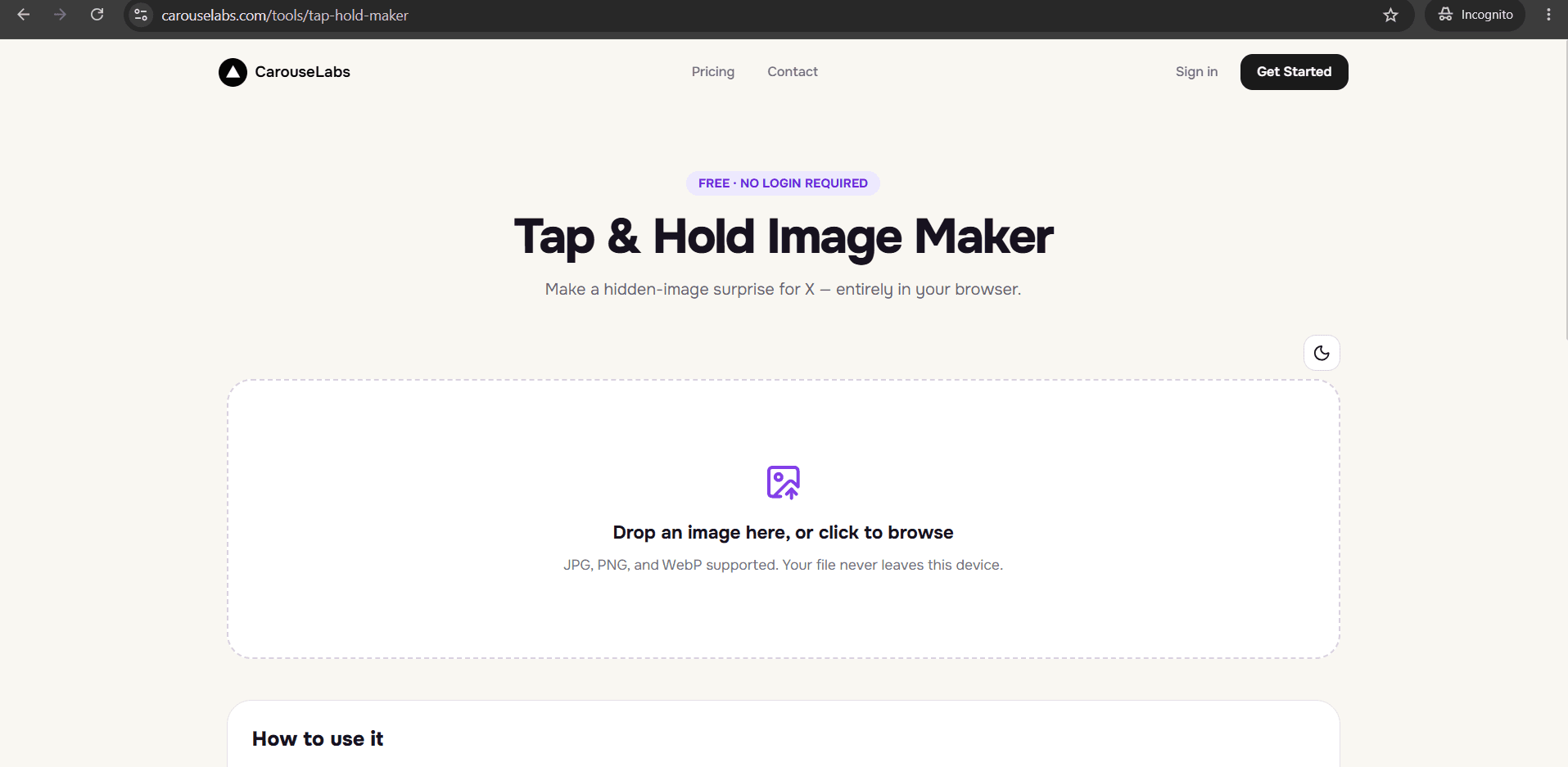
Everything here can be made with the free CarouseLabs Tap & Hold Image Maker. The tool does not limit what kind of image you upload, so it works as well for original art and photography as it does for memes.
What “Creative Tap and Hold Images” Means
In a creative context, a tap and hold image is a way to control the order in which a viewer experiences your work. Instead of showing everything at once, you choose what is seen first — a sketch, a detail, a fragment — and what is only revealed to someone curious enough to tap and hold.
That sequencing is what makes the format interesting to artists specifically. It turns a single static image into a two-step experience, which is difficult to achieve any other way within a normal X post.
Why People Use This Effect
Creative accounts use tap and hold images because they add a layer of interactivity to work that would otherwise be passively scrolled past. An illustration hidden behind its own rough sketch invites the viewer to participate in the reveal, rather than simply observe the finished piece.
The format also gives artists a natural way to show process and outcome in a single post, instead of splitting them across a thread or carousel — the sketch-to-final journey happens inside one image, triggered by the viewer's own action.
How to Create This with CarouseLabs
Here is how to turn a piece of art or photography into a tap and hold reveal using the free CarouseLabs Tap & Hold Image Maker.
- 1
Open the Tap & Hold Image Maker
Go to /tools/tap-hold-maker — free, no login, works directly in your browser.
30 sec - 2
Upload your finished artwork or photograph
Drag in the final piece you want to hide behind a teaser. It is processed locally in your browser, not uploaded anywhere during editing.
15 sec - 3
Paint the sketch, detail, or fragment that stays visible
Use the brush to mark only the portion meant to represent the 'before' state — a rough sketch line, a cropped detail, a single color block.
1-2 min - 4
Review the sequencing in both previews
Timeline View shows the first impression viewers get; Tap & Hold View shows the full piece. Make sure the transition between the two feels intentional, not abrupt.
30 sec - 5
Export in the format for your platform
Choose Download for X for the PNG-8 export tuned to X's compression, or the WebP option if you are sharing your work elsewhere.
10 sec - 6
Publish from a desktop browser
Post the file to X from desktop web so the reveal renders correctly when followers tap and hold on mobile.
20 sec
Try it as you read
Open the maker in another tab and follow along with the steps above.
Tips for Better Results
Use your own process work as the visible teaser
A rough sketch, wireframe, or early draft makes an authentic and meaningful teaser for a finished piece, rather than an arbitrary crop.
Think about pacing, not just concealment
A good creative reveal feels like a deliberate second beat in the storytelling, not just something randomly blocked from view.
Keep detail-heavy artwork legible at teaser size
Check Timeline View carefully — intricate art can look like noise rather than an intentional teaser at small scale.
Pair the reveal with a caption about your process
Mentioning the technique or time behind the piece adds context that a purely visual reveal cannot carry on its own.
Build a series across a body of work
If you have several finished pieces with early sketches, reuse the same sketch-to-final structure to build a recognizable running feature.
Examples
Sketch-to-final illustration
A pencil sketch stays visible while the fully colored, finished illustration is hidden underneath.
Macro detail reveal
An extreme close-up of a painting or photograph stays visible while the full composition is hidden.
Black-and-white to color reveal
A desaturated version of a photo stays visible while the full-color version is hidden for a dramatic contrast.
Silhouette-to-portrait reveal
A simple silhouette or outline stays visible while a detailed portrait is hidden underneath.
Negative-space art reveal
An abstract crop showing only negative space stays visible while the full composition is hidden as the payoff.
Common Mistakes
Hiding too little of a detailed piece
Fix: If most of the artwork is already visible in the teaser, the reveal loses its impact. Keep the visible portion small and intentional.
Using a teaser that has no visual relationship to the final piece
Fix: A teaser unrelated to the finished work confuses viewers instead of intriguing them. Base the visible fragment on an actual detail, sketch, or crop of the real piece.
Skipping the preview comparison
Fix: Always check both Timeline View and Tap & Hold View before exporting, since fine detail can behave differently than expected at small scale.
Posting from the X mobile app
Fix: Upload the final file from a desktop browser — the mobile app's compression can blur out the fine detail that makes creative reveals work.
Frequently Asked Questions
For artists and storytellers, a tap and hold image is a way to control pacing inside a single post — showing a sketch, detail, or fragment first, and letting the full piece exist as a discovery rather than an immediate view.
Try it with a finished piece and its early sketch in the free CarouseLabs Tap & Hold Image Maker to see how the sequencing feels.
Make your creative tap and hold images right now
Everything above happens inside one free browser tool — no signup, no design software.
Create your Tap & Hold image nowFree forever · Works entirely in your browser