How to Create a Reveal Image
Learn how to design and create a reveal image that actually lands, using the free CarouseLabs Tap & Hold Image Maker to build the visible teaser and the hidden payoff.
Free · No login required
Skip ahead and start now, or read the full guide below.
A good reveal works the same way whether it is a movie trailer, a magic trick, or a single image on X: you show just enough to create a question, then answer it in a way that feels worth the wait. A reveal image applies that same structure to a single picture — a visible teaser that hides a payoff underneath, unlocked only when someone presses and holds it.
The technical side of building one is simple once you have the right tool. This guide focuses on both parts of the job: the design decisions that make a reveal actually feel satisfying, and the exact steps to build it using the free CarouseLabs Tap & Hold Image Maker.
What “How to Create Reveal Image” Means
A reveal image is a single file that shows a partial, teaser version of itself in X's compressed timeline view, and a completely different, full version when a viewer presses and holds it. The split is not arbitrary — it relies on a real difference between how the platform compresses images for fast scrolling and how it renders the same file during a tap-and-hold preview.
Building one means intentionally shaping that split: painting only the teaser elements so they survive compression, while leaving the payoff visible solely in the full-quality render. That distinction is what turns a plain photo into something with a built-in moment of discovery.
Why People Use This Effect
Reveal images work because they borrow a structure people already respond to everywhere else — setup and payoff. A flat image asks nothing of the viewer, but a reveal image creates a small open loop: something is clearly hidden, and closing that loop requires an action, which makes the moment feel earned rather than passive.
That earned feeling is also what drives replies and shares. Once someone experiences a satisfying reveal, they tend to want either to tell others what they found or to try making one themselves, which is why the format keeps resurfacing across very different types of accounts.
How to Create This with CarouseLabs
Here is how to create a reveal image with a real setup-and-payoff structure, from a blank browser tab to a finished download, using only the free CarouseLabs Tap & Hold Image Maker.
- 1
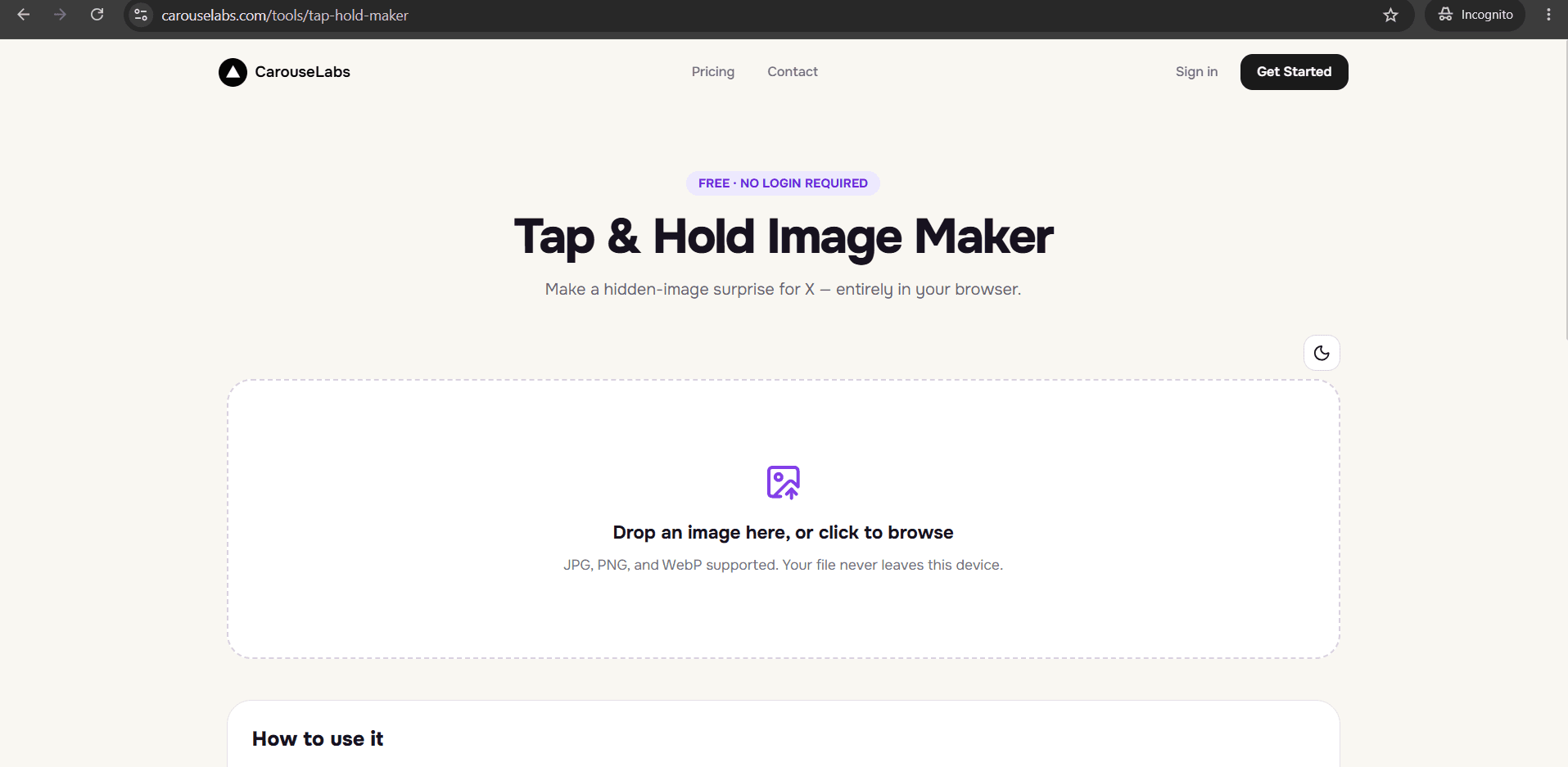
Open the Tap & Hold Image Maker
Go to /tools/tap-hold-maker. It is free, needs no account, and runs entirely in your browser on desktop or mobile.
30 sec - 2
Upload the image that contains your payoff
Drag in a JPG, PNG, or WebP file, or select one from your device. It stays local to your browser during editing.
15 sec - 3
Paint the teaser, leave the payoff hidden
Use the brush to mark only the setup portion — the part that should read as an intentional teaser in the compressed timeline. Leave the payoff area unpainted so it only shows during the full reveal.
1-2 min - 4
Preview the setup and the payoff separately
Timeline View shows the teaser as followers will first see it; Tap & Hold View shows the complete reveal. Check that the gap between the two feels intentional, not just cropped.
30 sec - 5
Download the finished reveal image
Choose Download for X to export an optimized PNG-8 built for the timeline's compression, or the WebP option for posting elsewhere.
10 sec - 6
Post it from a desktop browser
Upload the file to X from desktop web, not the mobile app, since the app can recompress the image and undo the reveal. Mobile followers can then tap and hold to see the payoff.
20 sec
Try it as you read
Open the maker in another tab and follow along with the steps above.
Tips for Better Results
Design the payoff first, then build the teaser around it
Decide what the satisfying part of the reveal is before you paint anything, then figure out the minimum visible teaser needed to set it up.
Make the teaser ask a question, not just show a fragment
A visible crop that clearly implies something is missing — an edge, a shadow, a partial shape — creates more curiosity than a random unrelated sliver.
Match the caption to the setup, not the payoff
Write your post text as if only the teaser exists. Referencing the hidden payoff in the caption spoils the reveal before anyone taps.
Keep the visible area under about a third of the frame
The smaller and more deliberate the teaser, the more contrast there is with the full payoff, which makes the reveal feel bigger.
Test the reveal on someone who has not seen it
Show a friend the Timeline View only and ask what they expect, then reveal the Tap & Hold View. If their guess was close, the payoff may need more contrast.
Examples
Plot twist reveal
A visible, neutral-looking scene teases a completely different image underneath that recontextualizes it.
Before-and-after transformation
The visible teaser shows a plain 'before' state, hiding a dramatic 'after' beneath it.
Guess-the-ending reveal
A partial, ambiguous crop invites replies guessing what the full image shows before it is revealed.
Announcement reveal
A blurred or partial teaser of a launch, event, or announcement hides the full detail until tap and hold.
Emotional payoff reveal
A plain visible setup hides a more emotionally resonant photo, timed for maximum contrast on reveal.
Common Mistakes
Building the teaser and payoff with no real relationship
Fix: A reveal lands best when the visible teaser hints at the hidden payoff. Choose a crop or detail that connects to what is being revealed rather than an unrelated fragment.
Giving away the payoff in the caption
Fix: Write the post text based on what is visible in Timeline View only. Save any explanation of the payoff for replies, after people have had a chance to reveal it themselves.
Leaving too much of the payoff visible in the teaser
Fix: Check Timeline View closely while painting. If the payoff is guessable from the teaser alone, shrink the visible area.
Posting from the X mobile app
Fix: Always upload the exported file from a desktop browser. The mobile app's compression pass is the most common reason a working reveal breaks after posting.
Frequently Asked Questions
Creating a reveal image that actually works comes down to intent: a teaser that earns curiosity and a payoff that answers it. The mechanics — painting the split and exporting the right file format — are handled automatically by the CarouseLabs Tap & Hold Image Maker, leaving the setup-and-payoff design as the only real work.
Open the free Tap & Hold Image Maker and build your first reveal now — most people finish their first one in a couple of minutes.
Make your how to create reveal image right now
Everything above happens inside one free browser tool — no signup, no design software.
Create your Tap & Hold image nowFree forever · Works entirely in your browser