What Is the Reveal Image Effect?
A reveal image effect deliberately withholds part of an image until the viewer takes an action to see the rest. On X, that action is pressing and holding — here's how it's built.
Free · No login required
Skip ahead and start now, or read the full guide below.
'Reveal image effect' describes a broader idea than any one platform: any image built so it shows less at first glance and more once the viewer interacts with it. On X, the specific interaction that triggers a reveal is tapping and holding the image, which is why the terms 'reveal image' and 'tap and hold image' are often used to mean the same thing in that context.
This page explains what defines a reveal image effect, why the interaction step matters as much as the image itself, and how to build one for X using the free CarouseLabs Tap & Hold Image Maker.
What “What Is Reveal Image Effect” Means
At its core, a reveal image effect has two states: an initial state that's intentionally incomplete, and a revealed state that shows more once triggered. What makes it an 'effect' rather than just two separate pictures is that both states come from a single file — nothing is swapped or loaded in. On X, the initial state is what the timeline's compression renders, and the revealed state is what the brief higher-quality render shows when a viewer presses and holds.
Building the effect means controlling how much of the image survives that first, compressed render. Areas painted to stay visible in the CarouseLabs Tap & Hold Image Maker are the ones that make it into the initial state; everything else is present in the file but only becomes visible once the tap-and-hold render kicks in. That's the entire mechanism behind the reveal — no animation, no second image, no extra layer.
Why People Use This Effect
The reveal image effect works because it turns a picture into a small mystery instead of a finished statement. A normal image is fully understood the instant you see it; a reveal image is deliberately unfinished until you interact with it, which creates a short gap between seeing and understanding that people are naturally inclined to close.
That gap is also what makes the effect easy to talk about — a reply saying 'the reveal is worth it' or 'tap and hold, trust me' works as free promotion, because it's a genuine recommendation rather than an ad, and each person who tries it and shares their reaction extends the effect's reach further.
How to Create This with CarouseLabs
Here's exactly how to build a reveal image effect for X using the free CarouseLabs Tap & Hold Image Maker.
- 1
Open the CarouseLabs Tap & Hold Image Maker
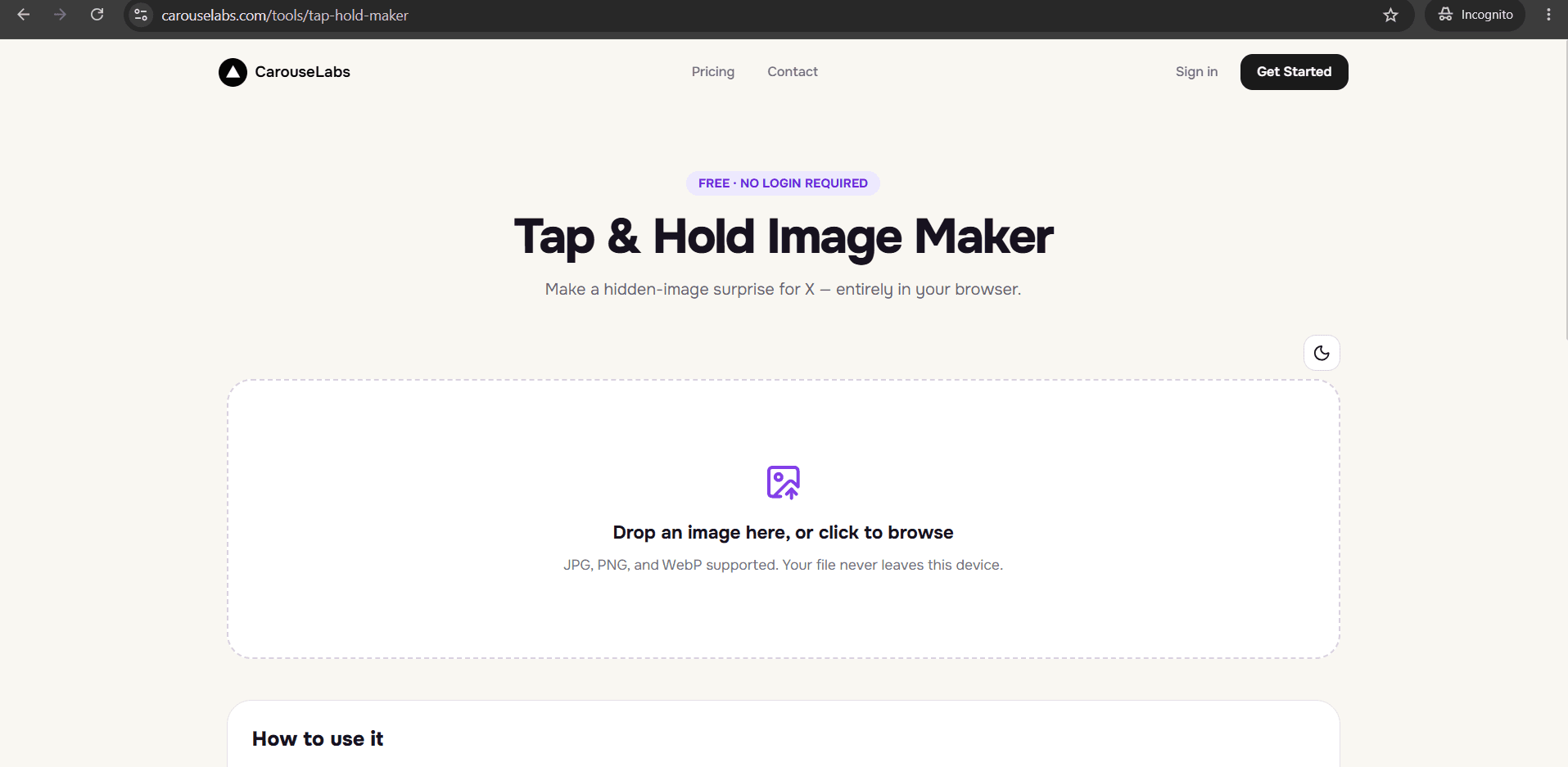
Visit /tools/tap-hold-maker. It's free, browser-based, and requires no account to start building a reveal effect.
30 sec - 2
Upload the image you want to build the effect from
Add a JPG, PNG, or WebP by drag-and-drop or file picker. Editing happens locally in your browser, not on a server.
15 sec - 3
Paint the initial state with the brush tool
Whatever you brush over becomes part of the initial, compressed view. Everything left unpainted becomes part of the revealed state instead. Undo and Clear let you adjust freely.
1-2 min - 4
Compare the initial and revealed states live
Timeline View shows the initial state as followers will see it while scrolling. Tap & Hold View shows the full revealed state. Toggle between them to judge whether the effect actually lands.
30 sec - 5
Download the finished effect
Export using 'Download for X' for a PNG-8 tuned to survive X's compression correctly, or choose WebP for use outside of X.
10 sec - 6
Post from desktop to preserve the effect
Upload the file to X from a desktop browser rather than the mobile app, since mobile uploads get recompressed in a way that can flatten the reveal. Viewers can then tap and hold to trigger it.
20 sec
Try it as you read
Open the maker in another tab and follow along with the steps above.
Tips for Better Results
Design the revealed state first, then work backward
Decide what the full picture should communicate once revealed, then choose the smallest visible slice that still makes the initial state worth noticing.
Keep the initial state intentional, not accidental
An initial view that looks like a mistake gets scrolled past. One that looks like a deliberate crop or teaser invites a second look.
Use the two preview panels as a side-by-side check
Flip between Timeline View and Tap & Hold View in the CarouseLabs Tap & Hold Image Maker to confirm the gap between the two states is as big as you intend.
Test with genuinely different image types
Portraits, text-based graphics, and scenic photos all reveal differently under compression — experiment to see which fits your idea best.
Export again after any adjustment
Each download reflects your canvas at that exact moment, so re-export whenever you tweak the brushed area.
Examples
Outline-to-full-color reveal
A muted or shadowed version of a subject stays visible; the full-color version is the revealed state.
Question-to-answer reveal
Text posing a question stays visible in the initial state; the revealed state shows the answer as an image.
Zoomed-in-to-zoomed-out reveal
A tight, ambiguous crop stays visible at first; the revealed state shows the full scene in context.
Empty-space-to-detail reveal
A mostly blank or dark composition stays visible; the revealed state fills in the missing detail.
Common Mistakes
Making the initial state too complete
Fix: If the first view already tells the whole story, there's no reason to tap. Trim the visible area down with the brush tool until real information is being withheld.
Making the initial state so empty it looks broken
Fix: An initial view with nothing recognizable can read as a failed upload rather than an effect. Leave at least one clear, purposeful visible element.
Skipping the desktop-upload step
Fix: Posting via the X mobile app can recompress the file and collapse the difference between the two states. Always upload the downloaded file from a desktop browser.
Assuming general photo editors can build this effect
Fix: The effect relies on how X specifically renders images at two different quality levels, which standard editors don't simulate. The CarouseLabs Tap & Hold Image Maker previews both states directly.
Frequently Asked Questions
The reveal image effect is defined by its two states — an intentionally incomplete initial view and a fuller revealed view — both coming from a single file rendered differently by X. Building one is really a design decision about what belongs in each state.
The clearest way to understand the effect is to build one. Open the free CarouseLabs Tap & Hold Image Maker and use the live previews to shape your own initial and revealed states.
Make your what is reveal image effect right now
Everything above happens inside one free browser tool — no signup, no design software.
Create your Tap & Hold image nowFree forever · Works entirely in your browser