How to Make a Viral Tap and Hold Image
Making a tap and hold image is easy. Making one that actually gets seen, replied to, and shared takes a few extra decisions — here is how to make both happen with CarouseLabs.
Free · No login required
Skip ahead and start now, or read the full guide below.
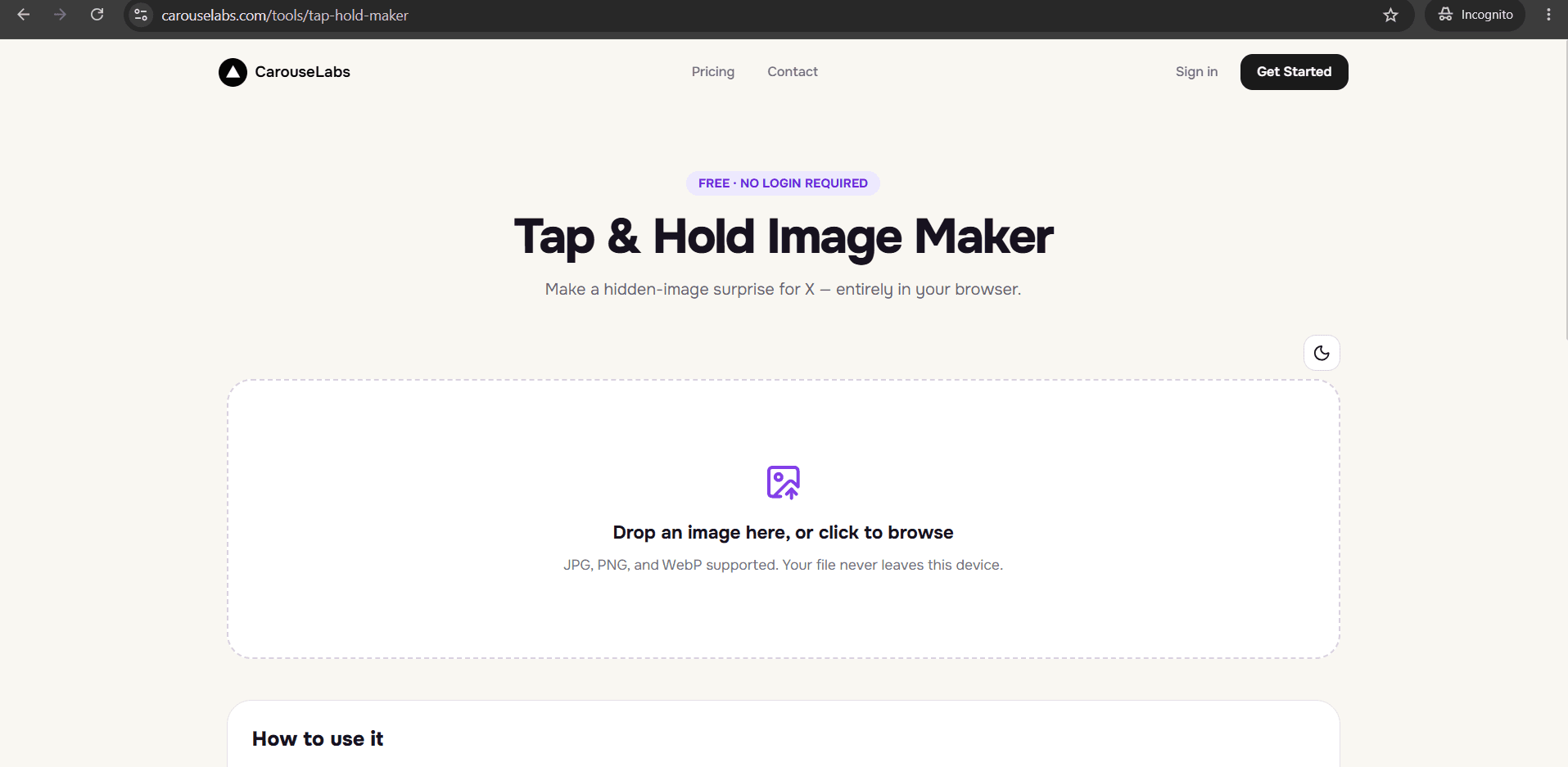
Plenty of tap and hold images get made correctly and still go nowhere, while others take off. The difference usually is not the technical build — it is the handful of decisions that determine whether a stranger scrolling past has a reason to stop, engage, and pass it along. This guide covers those decisions specifically, on top of the mechanics of building the image itself.
Every step below uses the free CarouseLabs Tap & Hold Image Maker, but the focus here is less on how to paint a mask and more on what makes people actually tap, hold, and react once they see it.
What “How to Make Viral Tap and Hold Image” Means
A tap and hold image displays one thing in X's compressed timeline view and a different, hidden thing once a viewer presses and holds it. That gap between the compressed render and the full-quality render is what makes the format interactive rather than passive — and it is also the entire mechanism virality relies on, since the interaction itself becomes the reason to engage.
Making one that spreads means treating that gap as a curiosity gap, not just a technical trick. The visible portion has to create a real question, and the hidden portion has to answer it in a way worth telling other people about — the brush tool and preview panels in CarouseLabs are what let you tune exactly how big that gap feels.
Why People Use This Effect
Tap and hold images travel further than a typical post because the action required to see the full content — pressing and holding — is unusual enough that people comment on it, which pulls in replies from users who have not yet tried it. Each reply becomes free distribution, since it surfaces the post to that replier's own followers.
They also benefit from platform mechanics: a press-and-hold interaction represents real, sustained attention on a post, which tends to be treated as a stronger engagement signal than a passive scroll-by. Posts that generate that kind of interaction are more likely to keep surfacing in more feeds.
How to Create This with CarouseLabs
Here is how to build a tap and hold image with virality specifically in mind, using only the free CarouseLabs Tap & Hold Image Maker.
- 1
Open the Tap & Hold Image Maker
Go to /tools/tap-hold-maker. It is free and requires no account, so you can test multiple ideas quickly without any setup friction.
30 sec - 2
Upload a source image with strong curiosity potential
Choose or crop a JPG, PNG, or WebP image with a clear subject. It is processed locally in your browser, so you can experiment freely before committing to one version.
15 sec - 3
Paint a teaser designed to raise a real question
Use the brush to leave visible only the smallest fragment that still implies something is missing. The goal is a visible portion people cannot fully explain to themselves without revealing it.
1-2 min - 4
Stress-test the curiosity gap in both previews
Compare Timeline View against Tap & Hold View and ask honestly whether the visible portion alone would make you stop scrolling. Adjust the mask until it does.
30 sec - 5
Download the optimized file
Use Download for X to export the PNG-8 format built for X's compression — this is the version most likely to actually preserve the effect after posting.
10 sec - 6
Post with a caption that sets up, not spoils, the reveal
Upload from a desktop browser, never the mobile app, and write a caption that references only what is visible — never the hidden payoff.
20 sec
Try it as you read
Open the maker in another tab and follow along with the steps above.
Tips for Better Results
Write the caption as a question, not an explanation
A caption like 'tap and hold' with no other context often underperforms one that hints at what the viewer might find, without giving it away.
Keep the visible portion small enough to feel incomplete
If the visible teaser already tells the full story, there is nothing left for the hidden portion to add. Aim for a fragment that clearly implies more exists.
Post when your audience is actually active
A curiosity-driven format depends on early replies to build momentum. Posting when your usual audience is online gives it a better chance of catching that initial engagement.
Don't repeat the exact same reveal structure every time
Novelty is a big part of why these spread. Vary what you hide and how — portrait crops, punchlines, spoilers — so the format does not become predictable to regular followers.
Reply to your own post explaining nothing
Let other users' replies do the explaining once people start revealing it. Jumping in with an explanation too early can shortcut the discovery that drives shares.
Test on a real device before posting
Confirm the reveal looks right on an actual phone. A curiosity-driven post that fails to reveal properly after people engage with it can backfire.
Examples
Guess-before-you-reveal post
An ambiguous visible fragment invites replies guessing what the full image shows, driving engagement before anyone taps.
Punchline reveal
A relatable setup image visible in the feed hides a payoff image that reframes it entirely.
Plot twist reveal
A neutral-looking teaser hides an image that recontextualizes what was just seen.
High-contrast transformation reveal
A plain visible 'before' hides a dramatic 'after,' maximizing the gap between the two states.
Community reaction bait
A visible detail intentionally leaves out the most interesting part of an image, prompting replies once revealed.
Common Mistakes
Making the visible teaser too generic
Fix: A vague or unrelated visible fragment does not create curiosity, it just looks like a bad crop. Choose a teaser that clearly implies something specific is hidden.
Spoiling the reveal in the caption
Fix: Write the caption based only on what is visible in Timeline View. Mentioning what is hidden defeats the entire mechanism that drives engagement.
Posting from the X mobile app
Fix: Always upload the exported file from a desktop browser. If the effect breaks after posting, the momentum a viral attempt needs is lost immediately.
Reusing the same reveal format too often
Fix: Vary the structure of what you hide across posts. An audience that has seen the same trick five times stops finding it worth engaging with.
Expecting virality from a low-effort source image
Fix: The reveal only feels rewarding if both the teaser and payoff are genuinely interesting. Choose source images worth building a reveal around, not whatever is convenient.
Frequently Asked Questions
A tap and hold image that spreads is built the same way a technically correct one is — upload, paint, preview, and export using the free CarouseLabs Tap & Hold Image Maker — with one extra layer of thought applied to the visible teaser, the caption, and the timing of the post.
Open the free Tap & Hold Image Maker, apply the ideas above to your next post, and give it the best possible chance of actually being seen.
Make your how to make viral tap and hold image right now
Everything above happens inside one free browser tool — no signup, no design software.
Create your Tap & Hold image nowFree forever · Works entirely in your browser